


Arabic + English Bilingual Websites: Why Dubai Businesses Need Them
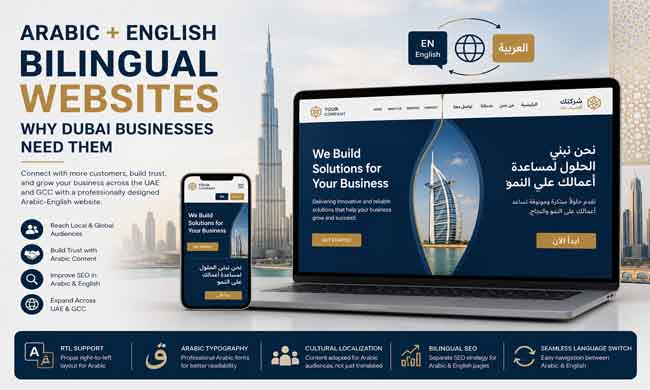
Arabic + English Bilingual Websites: Why Dubai Businesses Need Them
Meta Description (155 chars): Discover why Arabic-English bilingual websites are essential for Dubai businesses, and how the right web development company can build one correctly.
Target Keywords: bilingual website Dubai, Arabic website design Dubai, Arabic English website development, web development company in Dubai, multilingual website UAE, RTL website design, Arabic web design agency Dubai
Introduction
Dubai is one of the most multicultural cities in the world, but it's easy to forget one core fact: Arabic is the official language of the UAE, and a large share of local customers, government entities, and business partners expect to interact in Arabic first. Yet many businesses still launch English-only websites, quietly shutting the door on a huge portion of their potential audience.
A properly built bilingual website in Dubai, Arabic and English, isn't just a nice-to-have anymore. It's becoming a competitive necessity, and sometimes a legal expectation depending on your industry. Here's why it matters and what it actually takes to do it right.
Why Arabic Matters for Dubai Businesses ?
1. It's the Official Language
Government entities, free zone authorities, and many B2B partners in the UAE conduct business in Arabic. A bilingual site signals professionalism and respect for local business culture something purely English sites can miss entirely.
2. A Large Customer Base Prefers Arabic Content
While English is widely spoken in Dubai's business environment, a significant portion of UAE and wider GCC customers, especially in retail, healthcare, government services, and real estate, actively prefer browsing and reading in Arabic.
3. It Builds Trust With Local Audiences
Seeing content in their native language makes customers feel a brand understands and respects them. For sectors like healthcare, legal services, and real estate, this trust factor can directly affect conversion rates.
4. It Expands Reach Across the GCC
A well-built Arabic version doesn't just serve Dubai it opens the door to customers across Saudi Arabia, Kuwait, Qatar, and the wider Arabic-speaking region, all searching in their own language.
What Makes a Bilingual Website Different From Just "Translating" It ?
A common mistake businesses make is assuming bilingual means running content through a translation tool and pasting it in. A proper Arabic-English website development project involves much more:
RTL (Right-to-Left) Layout Support
Arabic reads right-to-left, which means the entire layout navigation, buttons, icons, and forms needs to mirror correctly. A site that simply swaps text but keeps an English left-to-right layout looks broken and unprofessional to Arabic readers.
Proper Arabic Typography
Arabic script requires different font families, letter spacing, and line-height than Latin script. Using a font that wasn't designed for Arabic often results in awkward, hard-to-read text.
Cultural Localization, Not Just Translation
Idioms, marketing phrases, and calls to action often don't translate directly. A skilled Arabic web design agency in Dubai adapts messaging so it feels natural to Arabic-speaking readers, not machine-translated.
SEO for Both Languages
Arabic and English pages need separate SEO strategies, different keywords, meta tags, and even different search behavior patterns. A site optimized only in English misses ranking opportunities in Arabic search results entirely.
Consistent Navigation Between Languages
Users should be able to switch languages seamlessly without landing on a broken page or being redirected to the homepage. A dedicated language switcher, properly linked page-to-page, is essential.
Industries Where Bilingual Websites Matter Most
| Industry | Why Arabic Content Is Critical ? |
|---|---|
| Government-related services | Often legally expected or strongly preferred |
| Healthcare & clinics | Patients often prefer explaining symptoms/services in Arabic |
| Real estate | Many GCC buyers and investors search in Arabic |
| Retail & e-commerce | Wider reach across UAE and GCC shoppers |
| Legal & consultancy services | Builds trust and clarity for local clients |
| Education | Parents and students often prefer Arabic-first browsing |
Common Mistakes to Avoid
- Using auto-translation plugins instead of professionally reviewed Arabic content
- Ignoring RTL layout issues broken alignment makes a business look unprofessional
- Treating Arabic as an afterthought bolting on a translation instead of designing for it from the start
- Skipping Arabic SEO meaning the site never actually ranks for Arabic search queries
- Poor font choices using fonts not optimized for Arabic script, hurting readability
How to Get a Bilingual Website Built Correctly ?
When choosing a web development company in Dubai for a bilingual project, ask about:
- Do they have native Arabic speakers reviewing content, not just automated translation?
- Can they show previous Arabic/RTL website projects?
- Do they handle Arabic SEO separately from English SEO?
- Is the CMS (e.g., WordPress) properly configured for RTL and multilingual management?
- Will the language switcher work smoothly across every page, not just the homepage?
Conclusion
For any business serious about growing in Dubai and the wider GCC, a bilingual Arabic-English website isn't optional anymore it's a direct reflection of how seriously you take your local market. Done properly, with real RTL design, native-quality Arabic content, and dedicated Arabic SEO, it becomes one of the most effective tools for building trust and expanding reach. Done poorly as a quick translation bolt-on it can do more harm to your brand image than having no Arabic version at all.
Looking to build a properly localized bilingual website for your Dubai business? Contact HubSol for a consultation on Arabic-English web development done right.
Comments